
Vyshyvanka Day

by Amanda Noullett

On the 3rd Thursday of May, many Ukrainian people and those of Ukrainian descent wear the traditional embroidered shirt (Vyshyvanka) to celebrate the unique culture and heritage of the Ukrainian people. As the top 10 ethnic origins of Canada (StatsCan 2021) you can understand why many people feel a very deep connection to the continued War in Ukraine, now into its fourth year. Vyshyvanka Day can be used to celebrate the unique culture and autonomy of the country of Ukraine.
Several years ago, I had the wonderful opportunity to help a local Ukrainian dance group organize costumes for its dancers. I learned so much about the different regions of Ukraine, and how each corresponded to different traditional styles of dress and embroidery.
Here are a few regions:

Poltava: This is probably the most recognizable in Alberta, usually characterized by great big red roses on the sleeves and along the front, sometimes coupled with a blue velvet vests, bright red leather boots and a crown of flowers. The men jump high in the air with voluminous red satin pants...reminiscent of MC Hammer.

Volyn: this was a new a new style to me when I started, you will often see a band of embroidery along the sleeves. One of my best friend's family immigrated directly from this region of Ukraine in the late 1800s. Tragically, when they got to the ship, before leaving the continent of Europe, it was discovered their daughter had an eye condition and was not allowed to travel with them. She was left behind with a relative. Happily, last summer the descendants of this daughter came to visit the rest of the family here in Canada.

Bukovyna: I love the embroidery from this region it is often very black, and characterized by geometric designs and parallel lines. Dancers hold their arms up high by their shoulders...I imagine to show off their sleeves!
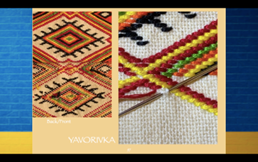
Hutsul: This embroidery is characterized by browns, oranges, greens, and yellows. The stitches are created on one side of the fabric, using a running stitch. This mountainous region costume has woolen vests and warm woolen socks.
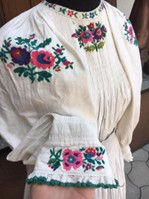
Transcarpathian: These shirts are so beautiful, very colourful flowers of red, purple, green, blue, yellow. Dancers full circle skirts are edged with bright rows of ribbons.
Many of those Ukrainians who immigrated in the late 1800s settled into large farming areas over the prairies. You will find in many small prairie towns today, old "onion domed” churches and Ukrainian dance groups. At many events they serve generous helpings of Perogies in Creamy Dill Sauce, big chunks of Kielbasa sausage and hand wrapped Cabbage Rolls in Tomato Sauce.

Another interesting connection is the “kookum scarf” a bright floral scarf that is popular in Indigenous culture, sometimes called Papooska...a Cree word derived from Babushka the Ukrainian word for grandmother, who wearing these scarfs, came to Canada and traded with the indigenous people of this land.
Like many immigrants today, everyone comes to Canada seeking a better life for themselves and their family. Overtime, our cultures blend together to create our own culture, Canadian. As the Ukraine War continues we can show support and celebrate the Ukrainian culture in Canada on May 21st.
Lesson Idea:
Wear a Ukrainian inspired embroidered shirt or floral scarf.
Literature: Read “Kohkum’s Babushka” by Marion Mutala
This book was adapted into a stage play and performed last fall at the Banff Centre of the Arts, it is said to be opening this year at Punctuate Theatre in Edmonton.
Music & Dance: Heel Toe Polka
This link shows the Northern Prairie Dancers, doing several advanced variations of the Heel Toe Polka, generally in the classroom I just do the partner heel toe part...and move around in a circle.
I like the version on Spotify by Reg Bouette for beginners, ‘cause it gives them an intro.
For more advanced, the version on Spotify by Burya, Ron Cahute is super fast and fun.
Art: Using wax-resist method create artwork inspired by Ukrainian Pysanka (decorated eggs). Although this craft is rooted in religious traditions, the craft can be introduced from an artist technique point of view. Using cardstock students can draw an oval shape (egg) or any shape and create rows of patterns along the shape in white wax crayon, afterwards using tempera block paint students can wash entire paper in colour. Let dry, cut out shape after.
One year I did a traditional Pysanka egg decorating lesson with my high school art class...for some reason we didn’t blow out the egg's insides....I brought one home and one warm sunny day it exploded in my kitchen!


